
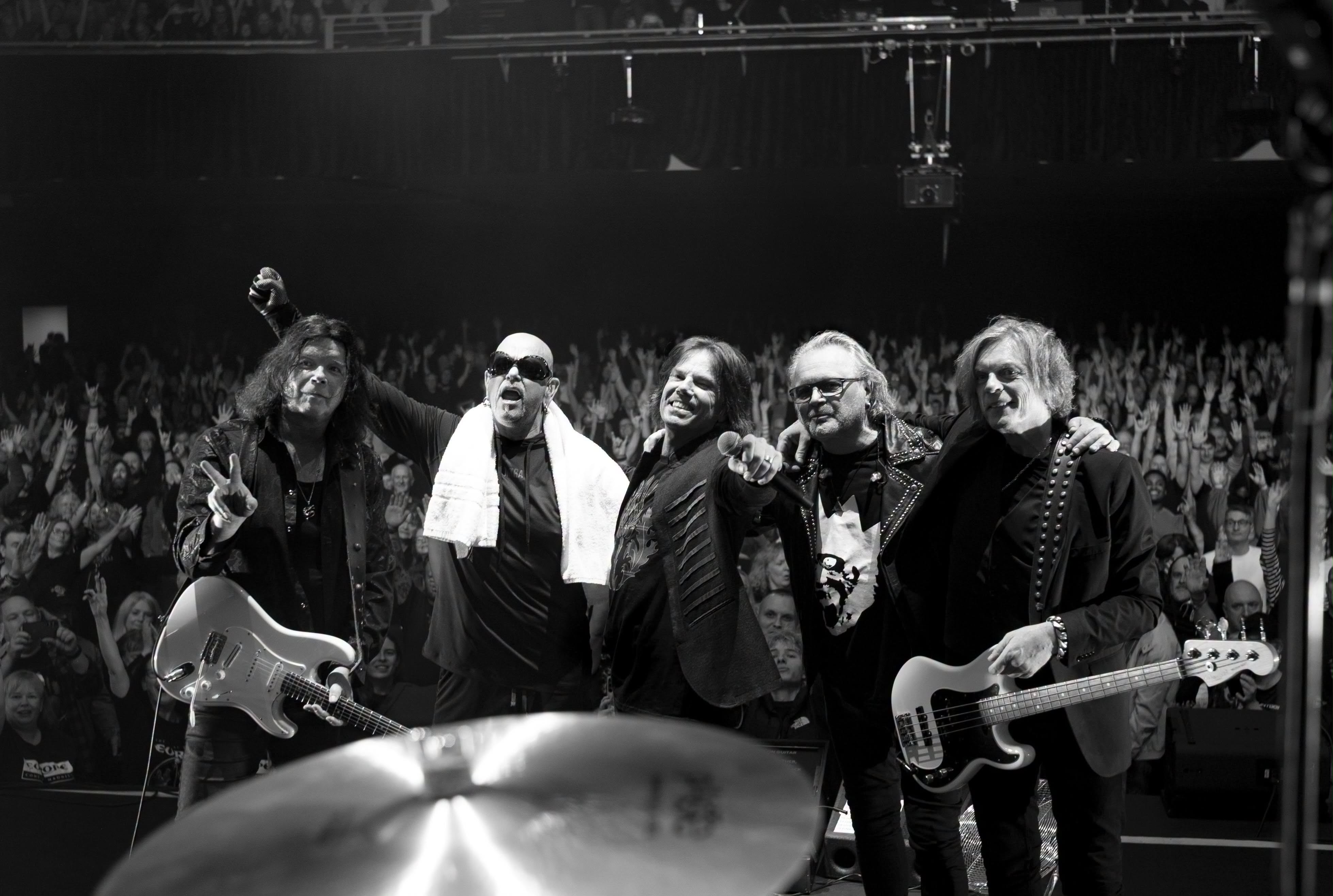
Europe has spent more than four decades building a legacy that continues to reach audiences around the world. In a conversation with Press Play Radio, drummer Ian Haugland reflects on the band’s remarkable journey, the music that shaped them, and what keeps Europe inspired after all these years.
For Haugland, the story began in 1976 when he attended his first real rock concert, seeing Rainbow in Stockholm with Ronnie James Dio, Ritchie Blackmore, Cozy Powell, Tony Carey, and Jimmy Bain. The experience completely changed his life. Watching Cozy Powell perform a dramatic drum solo, complete with a rising drum riser, smoke, and flashes, Haugland knew almost immediately that he wanted to become a drummer. At the time, he describes the musicians as almost godlike, since opportunities to see rock stars in person were rare.
That passion eventually led him to Europe, a band that would become one of the defining rock acts of the 1980s. The band’s breakthrough came with The Final Countdown, which became a worldwide phenomenon and reached number one in 25 countries. Haugland says the success gave Europe the opportunity to travel the world and perform for audiences across South America, Asia, Europe, and North America.
The story behind The Final Countdown is almost as unexpected as the song itself. Joey Tempest originally created the famous synthesizer introduction while experimenting with a synthesizer borrowed from future bandmate Mic Michaeli. At first, it was not even a complete song. A DJ in Stockholm later asked Tempest for a piece of music to use as the introduction to his club show, and the unfinished instrumental became the perfect opening.
When the band eventually heard the intro being used at the club, they realized its potential. What had started as a simple piece of music could become a show opener. Tempest developed it into a full song, and when Haugland first heard the finished demo in Joey’s car, he immediately felt that it was something special. It did not sound like anything Europe had previously created, nor did it feel like a typical hit song. The band originally wrote it as a show opener, though decades later it has become a powerful show closer.
Behind the massive success of the song was also a demanding recording process. Haugland remembers struggling with the galloping drum groove and spending an entire day trying to capture the right performance. After becoming frustrated, he decided to attempt it one final time before calling it a night. That last take finally nailed the part.
While The Final Countdown became Europe’s signature song, Haugland points to Cherokee and Rock the Night as two of his favorite tracks to play from the album because of the opportunities they gave him to experiment with fills and different elements of his drumming.
For Haugland, Europe has always been about more than individual songs. He describes the members as brothers who have experienced both highs and lows together. After nearly five decades, he says the band still feels incredibly fortunate to be able to pursue what has always been their passion.
That passion is also reflected in the band’s approach to writing new music. Haugland explains that Europe does not set out to make a specific type of song. Instead, they allow the music to take them on a journey. Emotion is at the center of the process, with the band allowing the music to determine where it should go.
That philosophy continues into Europe’s upcoming album, Come and Get It. Haugland describes the record as a reflection of the madness surrounding the modern world, with darker themes appearing throughout the lyrics. At the same time, he emphasizes that the music remains the driving force. He believes Joey Tempest has grown significantly as a lyricist over the band’s most recent albums, while the new record represents a major step forward in both songwriting and lyrics.
One of the clearest musical influences behind Europe is Deep Purple. Haugland explains that the band has always been heavily influenced by them, both as musicians and as a group. In fact, even Europe’s name came from Deep Purple, specifically their live album Made in Europe.
Those classic influences remain present in Europe’s music, but Haugland also appreciates discovering artists from later generations. When asked about music he has recently discovered, he points to Muse, describing them as a modern version of Queen because of their dramatic, theatrical, dynamic approach and strong songwriting and production.
He also remains fascinated by music from the 1960s, a period he believes produced some of the strongest songwriting. He points to The Beatles, Crosby, Stills, Nash & Young, and Jimi Hendrix among the artists from that era that continue to stand out to him. For Haugland, there was something exciting about the late 1960s because musicians were experimenting without the boundaries that exist today.
That appreciation for classic songwriting also connects to his thoughts on modern music. Haugland feels that many contemporary songs rely on similar chord structures, while the music of earlier generations often gave songs more room to develop. He believes that space is important because it allows emotion to become part of the music rather than filling every moment with sound.
That philosophy can be heard in Europe’s approach to recording. The band prefers to rehearse together in a rehearsal studio before entering the studio, allowing the musicians to understand the songs and refine their performances beforehand. For Haugland, making an album is not simply about creating songs. It is also an opportunity to develop as a musician and fine tune the details of their playing.
The new album continues that tradition. Haugland highlights Nothing Can Follow This as one of his favorite tracks because of its distinctive groove and the extra work that went into developing it. He also singles out Scandinavian Eyes and Cult of Ignorance, describing the latter as having an energetic groove reminiscent of AC/DC and ZZ Top.
After more than 40 years, Europe is still finding ways to move forward without losing the musicianship and emotion that made the band special in the first place. For Haugland, the ability to continue performing, creating music, and traveling the world is nothing short of a blessing. The Final Countdown may have defined one chapter of Europe’s story, but the band is still writing the next one.